
Are you thinking about specializing in electricity, but do not know where to start? A course for electrician is the gateway to a profitable and stable career in the labor market.In this practical guide, we will show you exactly how you can evolve in this profession and achieve concrete results.
Vocational training in electricity is not just about learning how to install wires and circuits.It is about acquiring solid technical knowledge, understanding safety standards, mastering specific tools and, above all, developing the ability to solve complex problems that arise in everyday life.
What you will learn in a course for electrician
A course for quality electricians will cover everything from the fundamentals of electricity to advanced practical applications.You will start by learning about electric current, voltage, resistance and how these concepts work together in circuits. This theoretical knowledge is essential because it allows you to understand why something works or fails, rather than just following a manual.
In practice, you will learn to read electrical schematics, a fundamental skill that separates a competent electrician from an amateur. Schemes are like maps that show exactly where each wire should go, what components are involved and how the system works as a whole. Mastering this reading turns you into a professional capable of executing any project accurately.
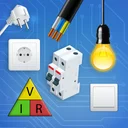
Manual do eletricista
SVA APPS
The course also covers the installation of residential, commercial and industrial systems.You will learn how to install sockets, switches, circuit breakers, distribution panels and high-voltage cables.Each of these elements has technical specifications that you need to know to ensure the safety and proper operation of the electrical system.
Maintenance and repair of electrical equipment are other critical components of training.You will learn how to diagnose problems using multimeters, power analyzers and other testing tools. This ability to quickly identify faults and correct them makes all the difference in providing quality service and increasing your billing.
Benefits of taking a course for electrician
When you complete a course for electrician, you not only acquire technical skills, but also professional safety.With formal certification, you can legally work on any type of project, from small residential renovations to large commercial works.Many customers and employers require this proof, then the certificate becomes your passport to better opportunities.
The labor market for electricians is always heated because the demand for these professionals grows continuously. Construction companies, industries, condominiums and homes constantly need qualified electricians for installation, maintenance and repairs. You can work as a freelancer with your own clientele, be hired by specialized companies or act as an entrepreneur opening your own business.
A qualified electrician earns significantly above average, especially when he creates a fixed customer base or specializes in industrial electricity.Specialized projects such as home automation, solar energy and security systems pay even more because they require specific knowledge that not every professional has.
In addition to the financial issue, you gain professional flexibility by mastering this specialty.You can work in CLT regime with stability, as a freelancer with total freedom of schedules, or even invest in your own business with your own employees. This versatility allows you to choose the work model that best suits your personal life and financial goals.
Typical structure of a course for electrician
Most courses for electrician are structured in progressive modules that start with theory and evolve into intensive practice. You will normally start with work safety, which is top priority in the profession.In this module, you learn about personal protective equipment, first aid, risk identification and procedures to prevent fatal accidents.
Subsequent modules cover mathematics applied to electricity, circuit fundamentals, electrical components and their technical characteristics.You study the behavior of components in different situations to understand how to build safe and efficient systems.This solid theoretical foundation is what allows you to innovate and solve problems you have not encountered before.
The practical part occupies half or more of the total time of the course, because experience is irreplaceable in this profession. You work in laboratories with workbenches equipped with real materials, practice with the same tools that you will use in the profession and carry out projects simulating real-world situations. Some courses include internship in partner companies, offering practical experience in real professional environments.

In the end, you typically undertake integrative projects where you apply everything you have learned in a single complex project. This may involve the complete installation of a residential electrical system in a mockup, or the resolution of a challenging technical problem. These final projects demonstrate your competence and often become portfolio to get your first jobs as a professional.
Practical results you get after the course
When you finish a well-structured electrician course, you get immediate jobs.Many schools and courses partner with companies that hire their graduates or offer job opportunities as soon as the course ends.
With the qualification in hand, you can gradually increase your income as you gain experience and reputation. A beginner electrician can start with modest gains, but as you accumulate satisfied customers and well-performed jobs, you can raise your prices and select your projects. Many electricians achieve monthly billing that significantly exceeds the average salary in the country.
Specialization in specific areas becomes possible after completion of the core course.You can take complementary courses in industrial electricity, automation, solar energy, air conditioning or safety systems.Each additional specialization amplifies your earning possibilities and makes you more valuable in the market. An electrician with knowledge in solar energy, for example, is positioned to participate in a rapidly growing market.
You also achieve professional stability because electricity is essential in any economy. Unlike professions that suffer from technological changes or market fluctuations, an electrician will always have demand. Homes need maintenance, businesses grow and need expansion of systems, new works are built constantly. This demand predictability ensures that you will always have job opportunities.
How to choose the best course for electrician
When looking for a course for electrician, you must first check the credibility of the institution and whether it has official recognition. A course recognized by the Ministry of Education or the competent institutions ensures that the degree will be accepted in the labor market and in selection processes. Check that the institution has a history of quality and recommendations of alumni.
The practical structure of the course is critical to your training. Visit the institution and note whether it has laboratories well equipped with real materials, whether it offers opportunities to practice with the right tools and whether it has partnerships with companies for professional internship. A course that is only theoretical will not adequately prepare you for the real challenges you will face in the first days of work.
Also analyze the profile of instructors and if they have real professional experience as electricians.An instructor who has spent years working in the profession brings practical knowledge that goes far beyond what is in the books.He shares craft tricks, shows how to deal with difficult situations and prepares you for the real challenges that only those who worked in the area know deeply.
Duration time is also important, but quality outweighs quantity. A well-structured course of 6 to 12 months is better than a poorly organized long course.You should also consider whether the course offers schedule flexibility if you are already working, or whether it offers online options combined with face-to-face practice. The ideal learning experience is one that fits your reality.
First steps after completing your course for electrician
Immediately after completing your course for electrician, you should focus on building your professional reputation. If you are going to work as a freelancer, invest in a professional visual identity, get your registration in the local city hall and create online presence where potential customers can find you. Clear communication and professionalism in the first interactions define your initial trajectory.
Seek initial jobs even if they are smaller, because each project is an opportunity to learn more and gain experience. The first jobs build your portfolio of references, which is your greatest asset as a professional. A satisfied customer who recommends his work to others creates a cycle of exponential growth. Quality and reliability are more important than quick profit in the first projects.
Keep up to date with technical standards and regulations of the profession. Electricity constantly evolves, new technologies emerge and standards are updated regularly. A professional who continues to learn and update remains competitive and can offer more modern and efficient solutions. This sets him apart from competitors working with obsolete techniques.
Also consider the importance of taking professional insurance and being legally regularized. Having liability coverage protects you from financial problems in the event of accidents. Being legally registered as a self-employed professional or entrepreneur ensures that you can receive receipts, formalize contracts and build a solid business on a legal basis. These initial actions seem bureaucratic, but are fundamental to your long-term career.