A viral app promises to identify ghosts through your phone, but does this technology really work? Social media is flooded with videos of people testing these tools and claiming to have captured supernatural presences.
Phantomize
Trek Mobi Connect
The truth is that many of these apps exploit our tendency to see patterns where none exist, a phenomenon called pareidolia. In this article, you'll learn to uncover the myths and truths behind these fascinating promises of paranormal detection through your smartphone.
The Viral Phenomenon: How One App Conquered Millions
In recent months, apps that promise to detect ghosts have gained exponential popularity, especially among teenagers and young adults curious about the paranormal. These programs use your phone's camera and sensors to supposedly reveal entities invisible to the naked eye. The proposal is simple: point your device anywhere and let the app "see" what you cannot.
What makes these apps so viral is the perfect mix between modern technology and ancient mystery. Many users share their results on video platforms, generating an entire community dedicated to exploring this possibility. However, it's crucial to question whether what you're seeing is truly paranormal or just a well-crafted technological illusion.
The Myth: Apps Really Detect Ghosts
The biggest myth is believing that these apps have special sensors capable of detecting paranormal energies or disembodied spirits. In reality, most of these programs use only the standard sensors in your phone: camera, accelerometer, gyroscope, and magnetometer. None of these components were developed to capture supernatural phenomena, because such phenomena have never been scientifically proven.
The creators of these apps are being clever in marketing, not in paranormology. They take advantage of sensors that exist in any modern smartphone and reinterpret them from a supernatural perspective. This means the app is processing real data from your environment but presenting it in a dramatized and mysterious way to impress the user.
The Truth: The Power of Pareidolia and Data Processing
The truth behind these apps is much closer to psychology than paranormology. Your brain has a natural tendency called pareidolia, which makes you see familiar faces and shapes in random patterns. When you look at clouds, you might see animals; when you look at a stained wall, you might see faces. Viral ghost detection apps exploit exactly this human characteristic.
These programs use simple algorithms that analyze images captured by your phone's camera and apply filters, pattern recognition, and even random visual effects. The app can highlight areas with greater contrast, display strange colors, or add digital auras to any object it detects. When you see a bright spot or a vague shape, your mind automatically tries to interpret it as something paranormal, especially if the app suggests that interpretation.
Your Phone's Sensors: What They Really Do
Your smartphone's camera is excellent at capturing visible light, but it cannot see paranormal energy spectrums because those spectrums don't exist in any scientific evidence. The accelerometer measures motion and changes in the device's speed, while the gyroscope detects rotations. The magnetometer identifies magnetic fields, like Earth's magnetic field. None of these sensors are equipped to detect ghosts or disembodied souls.
When you use a ghost detection app, it combines data from these sensors with the camera image and applies visual effects. A simple camera movement can be interpreted by the app as "paranormal activity," and a fluctuation in the magnetic sensor can be presented as "spiritual field detection." The app is being literally creative with mundane data, transforming normal readings into something that appears supernatural.
Why Apps Seem to Work for Many People
When you enter an old, dark, or reportedly haunted place, your mind is already programmed to expect to find something paranormal. This expectation influences how you interpret every signal. If the app flashes a red light, your mind immediately connects it to a ghost, even though the app was just reacting to a change in ambient lighting. This is one reason why many users swear the app works.
Furthermore, these apps were developed with very convincing interfaces, terrifying sound effects, and alarming messages. When you point at an empty area and the app says "Paranormal Entity Detected," your body intuitively experiences fear or amazement. Your brain registers this sensation as confirmation that something paranormal actually occurred, creating a memorable and shareable experience. You go home and tell the story, increasing the app's viral reach.
The Science Behind the Illusion
Scientists who study perception and psychology have extensively documented how easily our minds can be deceived. The confirmation bias makes you notice and remember the moments when the app "detected" something and ignore the many times it was a false alarm. This cognitive tendency is so powerful that you end up developing a genuine belief in the app's effectiveness, even though statistically it's only right by chance.
Studies on paranormology have also found that when people are in low-light environments or older structures, their vigilance increases and they become more susceptible to creative interpretations of what they see and hear. An object moving slightly from air currents suddenly seems like an apparition. A random sound of the house settling seems like a ghostly whisper. The viral app just amplifies these natural psychological effects.
The Business Side: Monetizing the Mysterious
It's important to recognize that behind every successful viral app is a financial goal. Developers earn money through ads, premium subscriptions, or paid versions. The more people are impressed with the results, the more the app spreads, the more downloads it receives, and the more revenue it generates. No one is actually trying to prove the existence of ghosts; they're trying to profit from humanity's fascination with the unknown.
The marketing strategies of these apps are well thought out. Digital influencers receive free versions and create viral content showing "ghost detections." Social media challenges encourage users to test the app in haunted places and share their videos. Each share is free advertising that expands the product's reach. You're actively participating in the commercialization of a myth, even if you haven't realized it.
Testing Reality: How You Can Verify
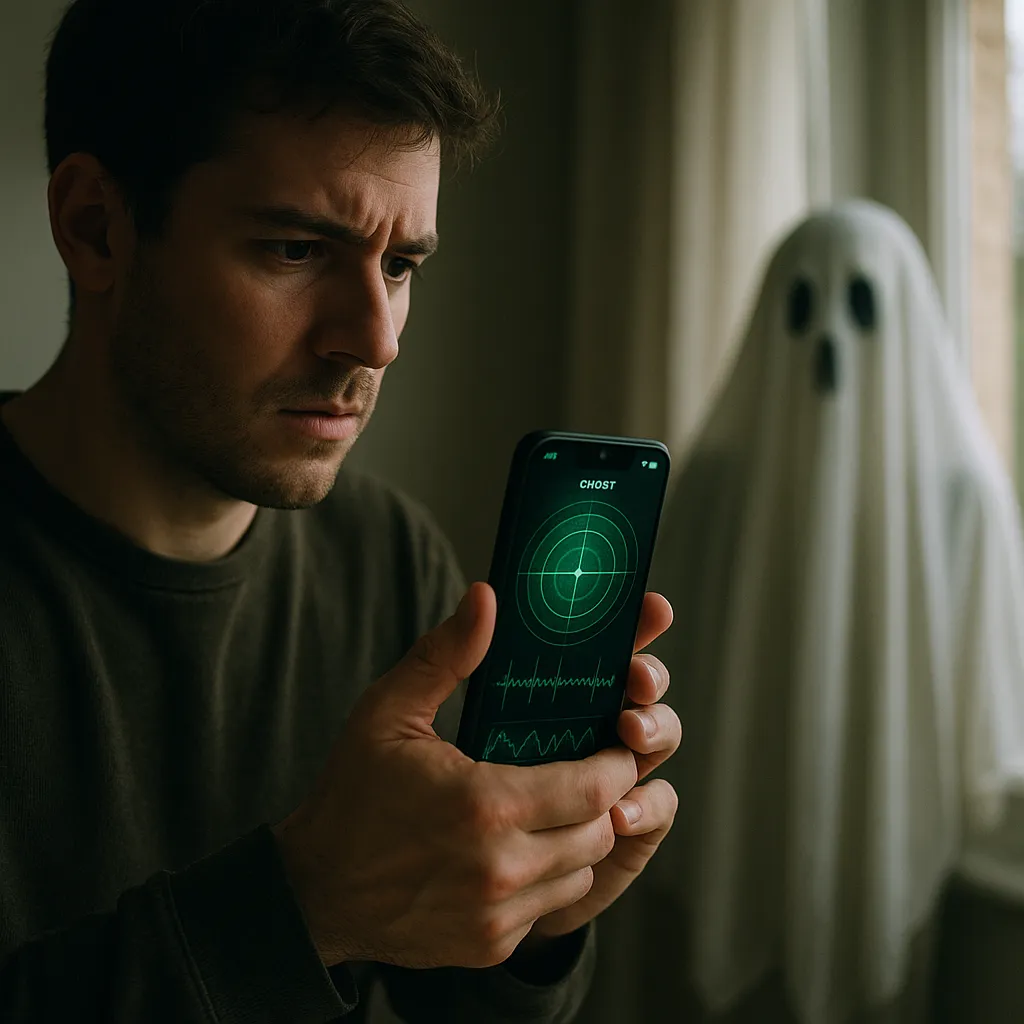
If you're still skeptical about these conclusions, there are simple ways to test the reality of these apps. Ask a friend to use the app pointing to an empty location without revealing to the program exactly where they're pointing. Then you point to the same location and observe whether you get the same results. If the app really detected ghosts, the results should be consistent and not dependent on user suggestion or expectation.
Another interesting test is to use the app in completely different environments: a lit store, a park during the day, your office with fluorescent lights. If the app claims to detect ghosts equally in all these places, this suggests it's not really distinguishing between paranormal and normal, but just generating random results or based on simple image processing patterns. Compare your results with friends and family to identify patterns. If everyone is interpreting the same detections differently, then the app isn't detecting anything objectively.
The Difference Between Fun and Belief
Using a ghost detection app can be fun and interesting, as long as you understand it's entertainment, not paranormal technology. Many apps do exactly this: they offer an interactive and mysterious experience that can be enjoyed as a game or a form of storytelling. The problem arises when people start to genuinely believe that the app has real paranormal detection capabilities.
False belief in supernatural possibilities can lead to harmful decisions. Someone might avoid a place because the app "detected paranormal activity," even though the location is perfectly safe. Other people might ignore signs of real problems in their homes (like structural issues or infestation) because they're focused on paranormal explanations. The distinction between fun and belief is crucial for your safety and well-being.
The Psychological Appeal of the Paranormal
Understanding why these apps are so attractive helps us be more critical of what we consume. Humans naturally feel drawn to mystery and the unknown. The paranormal offers an explanation for the disturbing experiences we sometimes have, making the world less random and more full of meaning. An app that promises to reveal ghosts directly touches that deep desire to connect with something greater than ourselves.
Additionally, sharing paranormal experiences creates community. You feel part of a group of people who also see the world differently, who question conventional reality. This sense of belonging is powerful and can make you want to stay engaged with the app, even if you rationally know the results may not be reliable. The social experience of using and discussing the app often outweighs the actual technical value of the program.
More Reliable Alternatives for Exploring the Paranormal
If you're genuinely interested in paranormology as a subject, there are more reliable and informed approaches than relying on a mobile app. Legitimate paranormal research organizations use specialized equipment and scientific methodologies, even if they study topics that conventional science has not yet fully explained. These researchers don't claim to have definitive proof but document investigations with rigor.
Books on paranormal history, documentaries exploring famous cases, and communities of enthusiasts discussing sightings and personal experiences can satisfy your curiosity in a more enriching way than an app. You'll learn about the cultural history of fear and mystery, understand why certain stories persist through the centuries, and develop a more balanced perspective on the relationship between belief and evidence. This type of exploration respects your intelligence and genuine curiosity.
The Future of Augmented Reality and the Paranormal
As augmented reality technology advances, we can expect paranormal detection apps to become even more convincing and immersive. Developers will continue improving visual effects, adding more sophisticated motion tracking, and creating experiences that seem even more real. This technological evolution won't make the app more accurate at detecting ghosts, but it will make the illusion considerably more convincing.
It's crucial to maintain your critical ability as technologies advance. Just because an app can create an immersive and visually impressive experience doesn't mean it's detecting something real. Technological sophistication can actually make it easier for you to fall for the deception, because your mind will be less inclined to question something that seems so well-produced and professional. Technological literacy and critical thinking become even more important as we live in a world where the fictional can be presented with extreme conviction.
Digital Responsibility and Misinformation
As a user of apps and digital content, you have a responsibility to verify the information you consume and share. When you spread a video claiming that an app detected a ghost, you're contributing to misinformation, even if your intentions are just to entertain friends. Misinformation accumulates on the internet, creating alternative realities where many people believe in things that have no factual basis.
Before sharing results from a paranormal app, consider the message you're sending. Are you encouraging other people to trust dubious technology to explain complex phenomena? Are you reinforcing the idea that these apps have real capabilities? A more responsible approach would be to share with a humorous or critical note, making it clear that you understand it's entertainment, not actual detection. This transparency helps maintain a healthier informational ecosystem.
Recognizing Manipulative Techniques in Apps
There are several techniques that developers use to make their paranormal detection apps more convincing. The first is controlled randomness: the app can randomly display detections even in a perfectly normal environment, creating an illusion of consistent functioning. The second is the intimidating interface with scary sounds, flashing red colors, and dramatic messages that amplify any emotional reaction you have.
Another technique is confirmation bias by design. The app is structured so you're more likely to find confirmation of paranormology than to not find it. If you see a detection, you interpret it as evidence. If the app detects nothing, you might assume there was no paranormology present. Either way, your belief in the app is reinforced. Recognizing these techniques consciously or unconsciously used helps you be more critical of what these tools can really do.
You now understand that apps that promise to identify ghosts exploit human psychology and simple technology to create convincing illusions. Pareidolia, psychological expectation, and manipulative design work together to create an experience that seems paranormal but is fundamentally based on common image processing and creative interpretation of mundane data. Keep this critical perspective in mind the next time you encounter a promising viral technology, and you'll be more resistant to digital misinformation.